
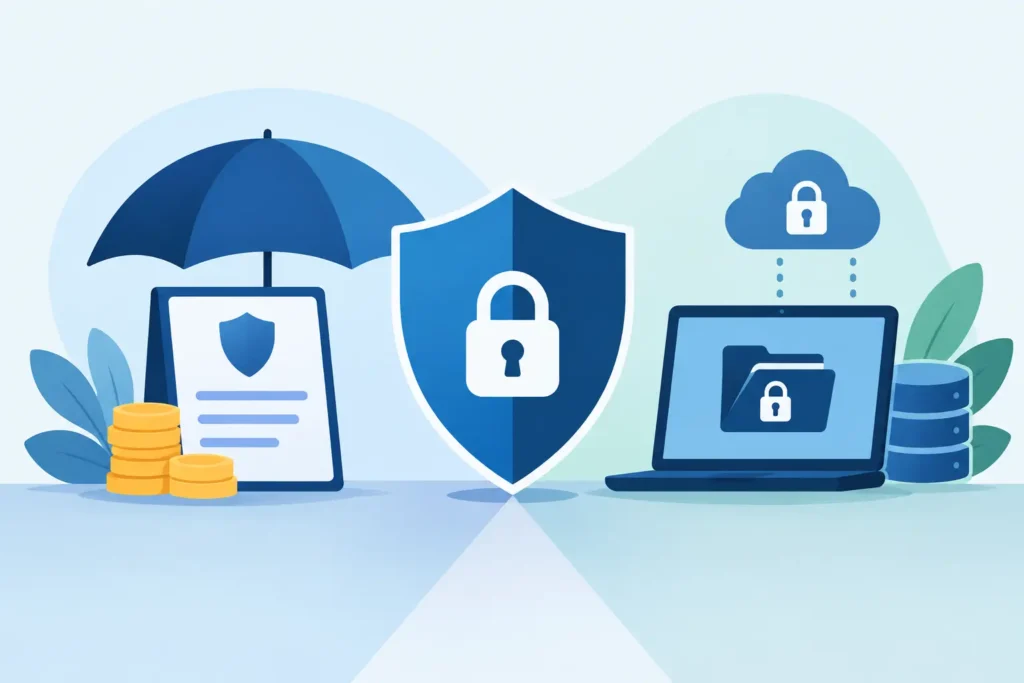
A suspicious email reaches an employee’s inbox at 8:15 a.m. By lunchtime, a stolen password may have opened access to customer records, accounting systems, or vendor payment details. In that moment, cyber insurance vs data protection is not really an either-or decision. One helps reduce the chance and impact of an incident; the other can help your business afford and manage the consequences when prevention fails.
For small businesses, professional firms, retailers, contractors, and growing companies, both matter. The right balance depends on what information you hold, how your systems operate, what contracts require, and how much disruption your business can absorb. Understanding the difference is the first step toward making decisions before a cyber event forces them.
Cyber Insurance vs Data Protection: The Core Difference
Data protection is the work your business does to keep sensitive information secure, accurate, available, and properly handled. It includes the people, policies, and technology that protect customer data, employee records, financial information, login credentials, and business systems.
Cyber insurance is a financial protection tool. Depending on the policy, it may help cover certain costs after a covered cyber incident, such as ransomware, data recovery, forensic investigation, legal support, customer notification, credit monitoring, public relations assistance, and business interruption. It can also provide access to incident-response professionals when time matters most.
The distinction is simple: data protection aims to prevent or limit harm, while cyber insurance helps your business respond to covered losses that still occur. Insurance does not replace security controls, and strong security controls do not eliminate every risk.
Why Strong Data Protection Comes First
A cyber policy can be a valuable part of your risk plan, but it cannot restore trust overnight or erase operational disruption. If a phishing attack stops your business from invoicing customers, accessing job files, or processing payroll, the immediate priority is getting safely back to work. Good data protection makes that recovery faster and less costly.
For many businesses, the most effective protections are not exotic or difficult to understand. They are consistent practices: using multifactor authentication, keeping software updated, maintaining secure backups, limiting access to sensitive records, and training employees to spot suspicious messages.
Data protection also affects your ability to obtain and keep cyber coverage. Insurers commonly ask about security measures during the application process. Questions may address multifactor authentication, backup procedures, endpoint protection, employee training, password controls, and the handling of wire transfers. A business with basic controls in place may have more coverage options and a clearer picture of its exposure.
That does not mean every business needs the same security program. A one-person consulting practice has different needs than a medical office, law firm, manufacturer, or cannabis operation with regulated information and multiple locations. The goal is to match safeguards to the data you collect and the way you do business.
The data you may be protecting
Sensitive data is broader than a list of customer credit card numbers. It can include names and addresses, Social Security numbers, health information, payroll files, tax documents, banking details, proprietary designs, client contracts, and email accounts. An email takeover can be damaging even when no formal database is compromised, especially if criminals use the account to request fraudulent payments from customers or vendors.
A practical starting point is to identify where this information lives. Is it stored in cloud applications, laptops, mobile phones, paper files, point-of-sale systems, email inboxes, or a vendor platform? You cannot protect data effectively if no one knows where it is stored or who can access it.
What Cyber Insurance May Help Pay For
A cyber event creates expenses quickly. There may be a need to hire technical experts, determine what happened, notify affected individuals, meet legal obligations, respond to demands from attackers, or restore information from backups. A well-designed cyber policy can help address eligible expenses, subject to its limits, deductibles, conditions, and exclusions.
First-party coverage generally concerns the costs your own business faces. This can include forensic services, data restoration, crisis communication, notification expenses, and income loss from a covered interruption. Some policies also address cyber extortion, though payment decisions should always involve legal counsel, law enforcement considerations, and the insurer’s incident-response team.
Third-party coverage generally addresses allegations that your business failed to protect someone else’s information or systems. If a customer, client, partner, or regulator brings a claim after a breach, the policy may help with defense costs and certain settlements or penalties where allowed by law and covered by the policy.
Coverage is never automatic simply because an event occurred. The details matter. A policy may have separate limits for ransomware, funds-transfer fraud, business interruption, or regulatory expenses. It may also define a cyber event narrowly, require prompt reporting, or exclude losses tied to known incidents, dishonest acts, or inadequate contractual safeguards. Reading the policy before a loss is far easier than sorting through it during one.
When Insurance Cannot Solve the Main Problem
Cyber insurance can support recovery, but it cannot guarantee that every lost customer will return. It cannot instantly rebuild a damaged reputation, recreate records that were never backed up, or remove the stress of notifying clients that their information may have been exposed.
It also may not cover every financial loss connected to social engineering or payment fraud. For example, an employee who receives a convincing email that appears to come from a vendor may change bank instructions and send money to a criminal. Some cyber policies offer social engineering or funds-transfer fraud coverage, but the scope can vary significantly. A business should not assume that a general cyber policy treats every fraudulent transfer the same way.
The best approach is to build simple verification procedures alongside insurance. Require a phone call to a known contact before changing payment instructions, use dual approval for larger transfers, and restrict who can access banking platforms. These steps are often inexpensive and can stop a costly mistake.
Building a Practical Layered Plan
Cyber risk management does not have to begin with a massive technology project. It begins with a realistic conversation about your operations, your data, and the disruption you could withstand. A layered plan brings prevention, response, and financial protection together.
Start by reviewing these four areas:
- Access: Use multifactor authentication, unique passwords, and role-based access so employees can reach only the information they need.
- Backups: Keep current backups, protect them from the main network where possible, and test whether files can actually be restored.
- People: Train employees on phishing, suspicious attachments, password practices, and payment-change requests. Repeat training because threats change.
- Response: Document who will make decisions, contact technology providers, notify the insurer, communicate with customers, and keep operations moving after an incident.
These are not one-time tasks. A new employee, software system, vendor relationship, or remote-work arrangement can change your exposure. Review your safeguards at least annually and after a meaningful change in your business.
Choosing Cyber Coverage That Fits Your Business
The right cyber policy begins with questions, not a generic limit. How much revenue could be lost if your systems were unavailable for several days? Do you store private client information? Could a vendor’s security failure affect your operations? Are you responsible for payment information, health records, or confidential professional files? Do client contracts require specific cyber liability limits?
A restaurant using a payment processor, a law firm maintaining confidential case files, and a contractor relying on email for payment approvals may all need cyber coverage, but their priorities are different. The restaurant may focus on payment-card exposure and interruption. The law firm may need protection for confidential client data and legal defense. The contractor may be especially concerned about email compromise and fraudulent transfer requests.
Look beyond the policy limit. Ask how business income loss is calculated, whether dependent business interruption is included, what sublimits apply, whether the insurer provides a breach-response team, and how quickly an incident must be reported. Also review the application carefully. Inaccurate answers or security practices that differ materially from what was represented can create serious claim issues.
An experienced independent insurance advisor can help translate those questions into plain English and compare coverage with your actual operations. For New Jersey, New York, and Florida businesses, that personalized review can be particularly helpful when state rules, contracts, and industry requirements add complexity.
The Better Question to Ask
Rather than asking whether to spend on cyber insurance or data protection, ask where a single incident would hurt your business most. If one compromised email account could interrupt payroll, expose client records, or trigger a fraudulent payment, you need both practical safeguards and a response plan that includes insurance.
Start with the controls that address your most likely risks, then select coverage that supports the way your business would recover. The goal is not to promise that a cyber incident will never happen. It is to make sure one bad click does not become a business-ending event.