
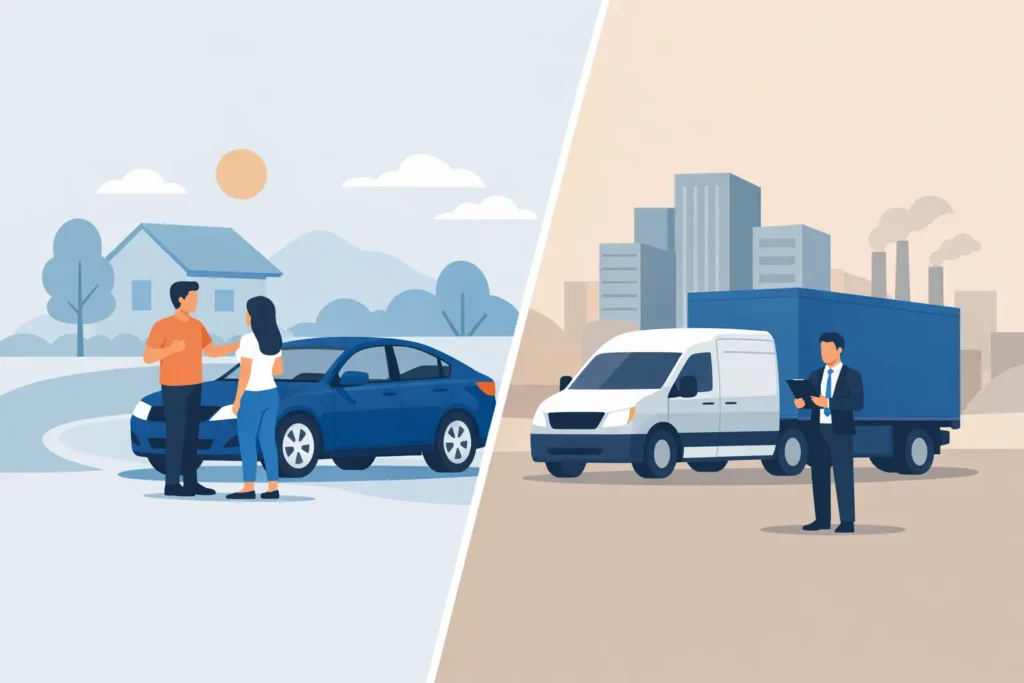
A lot of coverage problems start with a simple assumption: “It’s my car, so my personal policy should cover it.” Sometimes that is true. Sometimes it is not. When you compare personal auto vs commercial auto, the real issue is not who holds the keys. It is how the vehicle is used, who is driving it, and what kind of risk the insurer agreed to take on.
That distinction matters for families, side hustles, and established businesses alike. If you use a vehicle for work in ways your personal policy does not allow, a claim can become much more complicated than expected. The good news is that the difference is easier to understand once you look at the purpose of the vehicle, not just the vehicle itself.
Personal auto vs commercial auto: what is the difference?
Personal auto insurance is designed for private, everyday driving. That usually includes commuting, errands, family trips, and other normal household use. The policy is built around individual drivers and personal vehicles, with pricing and coverage based on that lower-risk profile.
Commercial auto insurance is built for business use. It covers vehicles used in connection with a business, whether that means transporting tools, making deliveries, visiting job sites, carrying employees, or driving clients. The policy is meant to address a wider and often more serious range of risks, including higher mileage, multiple drivers, heavier vehicles, and greater liability exposure.
The difference is not just a label. It affects who is insured, what types of use are covered, and how claims are handled. A business-owned pickup truck, for example, may look no different from a personal truck in the driveway. But if it is used every day for contracting work, the insurance need is different.
When a personal auto policy may be enough
A personal auto policy is often the right fit when the vehicle is owned by an individual or family and used mainly for non-business purposes. Driving to an office job, picking up groceries, taking children to school, or visiting friends would usually fall into this category.
There are also situations where limited business use may still fit within a personal policy. A person who occasionally drives to meet a client or attends off-site meetings may still be fine under personal auto coverage, depending on the carrier and policy language. That is where people can get tripped up. “Business use” does not mean exactly the same thing from one insurer to another.
This is why details matter. If the work-related driving is infrequent and low-risk, your personal policy may still be appropriate. If the vehicle becomes part of how you earn income, the answer can change quickly.
When commercial auto is usually the better choice
If a vehicle is central to business operations, commercial auto is usually the safer and more appropriate option. This includes vehicles owned by a business, titled to an LLC or corporation, or regularly driven by employees. It also applies when the work itself increases the chance of an accident or a larger liability claim.
Common examples include contractors driving to job sites with equipment, florists making deliveries, real estate teams with multiple drivers, cleaning companies transporting supplies, and professional service firms that have employees using company cars. Commercial auto can also make sense for sole proprietors whose personal vehicle is used heavily for work.
The key question is whether the vehicle is simply getting you to work or actively being used for work. If it is carrying tools, products, passengers, or employees as part of the business, that is often where commercial coverage enters the conversation.
Why business use changes the insurance risk
Insurance pricing and underwriting are based on risk. Business use usually means more time on the road, more stops, more drivers, and more pressure to stay on schedule. All of that can raise the chance of an accident.
There is also the liability side. If a crash happens while someone is conducting business, the claim may involve more than vehicle damage and medical bills. There may be questions about employer responsibility, hired drivers, cargo, equipment, or injuries to customers and third parties. That is a broader risk than most personal policies are meant to cover.
This is one reason small business owners should be careful about assuming they can save money by keeping everything under a personal auto policy. The lower premium may not mean much if the claim falls into a gray area or outside the policy altogether.
Coverage differences in personal auto vs commercial auto
Both personal and commercial auto policies can include liability, collision, comprehensive, uninsured motorist protection, and medical-related coverages. What changes is how those coverages are structured and how far they need to go.
Commercial auto policies often allow for higher liability limits because business-related claims can be more expensive. They may also include coverage for vehicles not owned by the business but used for business purposes, or for employees who drive company vehicles. Depending on the situation, a business may need hired and non-owned auto coverage, which is something many personal policies do not address.
Another major difference is flexibility. Commercial policies are generally better suited for multiple drivers, changing vehicle schedules, and specialty vehicles. A personal policy is simpler by design. That simplicity works well for household driving, but it can leave gaps when a business starts growing.
Gray areas that cause the most confusion
Not every situation is obvious. That is where careful review matters.
Take a self-employed consultant who drives to client meetings a few times a week in a personal sedan. Some insurers may accept that under personal coverage with the right classification. Others may want a commercial policy or an endorsement. A rideshare driver faces a different issue entirely, because personal policies often exclude livery or for-hire driving unless a specific endorsement is added.
Delivery work is another common problem area. Delivering pizzas, packages, groceries, flowers, or other goods often creates a business-use exposure that a standard personal policy may not cover. The same is true for a contractor using a pickup truck to haul tools and materials every day.
Business ownership can also change the answer. If the vehicle is titled in the name of a business, a personal auto policy is usually not the right fit, even if only one person drives it.
How to tell which policy you may need
A useful starting point is to ask a few simple questions. Who owns the vehicle? Who drives it? How often is it used for work? Is it carrying tools, goods, or passengers? Is the vehicle listed under a business name? Would an accident potentially involve your business in a lawsuit?
If your work use is occasional and limited, personal auto may still be enough. If the vehicle is an active part of your business operations, commercial auto is often the better answer. The challenge is that many people live somewhere in between, especially freelancers, real estate professionals, gig workers, and owners of small service businesses.
That is why plain-English guidance matters. A short conversation before a claim is far easier than arguing over coverage after a loss.
Cost matters, but so does the size of the risk
Commercial auto usually costs more than personal auto, and there is a reason for that. The policy is taking on a broader set of exposures and often providing higher limits or more specialized protection.
But the right comparison is not just monthly premium versus monthly premium. It is the cost of proper coverage versus the cost of a denied claim, a liability lawsuit, or a gap that affects your business and personal finances at the same time. For many business owners, commercial auto is less about buying more insurance and more about putting the risk in the right place.
At NewEdge Insurance Agency, these are the conversations we help clients work through every day, especially when a vehicle serves both personal and business needs.
Don’t wait until after an accident
The most common mistake is waiting until a claim happens to find out how the policy views the vehicle. By then, the facts are fixed, and so is the insurer’s coverage position.
If your driving habits have changed, your side business has grown, or employees now use a vehicle that used to stay in the family, it is worth reviewing the policy now. Personal auto vs commercial auto is not just an insurance technicality. It is one of those decisions that can affect whether protection holds up when you need it most.
The best policy is the one that matches how you actually live and work, with enough clarity that you are not left guessing after the fact.