
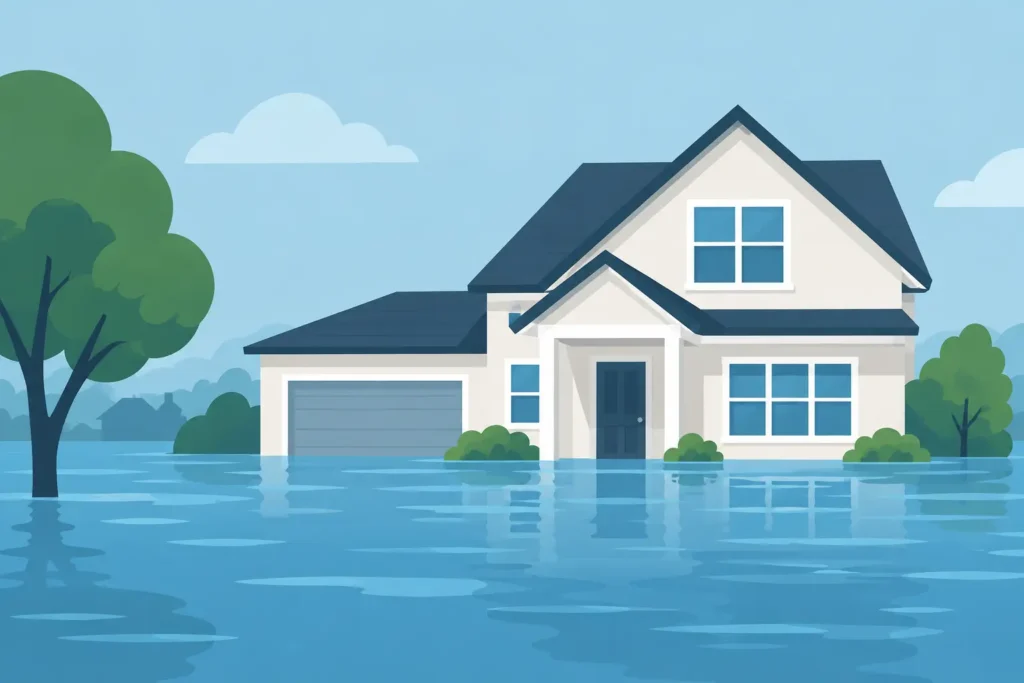
A home can be outside a high-risk flood zone, have never taken on water, and still be required to carry flood coverage. So, when is flood insurance required? Most often, it is required when a property in a designated high-risk flood area is financed with a mortgage from a federally regulated or federally insured lender. But the details matter, especially if you are buying, refinancing, owning a condo, or operating a business.
Flood insurance is not the same as homeowners or commercial property insurance. Standard policies generally do not cover damage caused by rising water, storm surge, overflowing rivers, or heavy rainfall that enters from outside the building. A separate flood policy fills that gap.
When Is Flood Insurance Required by a Lender?
Federal law generally requires flood insurance when all three of these conditions apply: the building is located in a Special Flood Hazard Area, commonly called a high-risk flood zone; the loan is secured by that building; and the lender is federally regulated, federally insured, or otherwise connected to a federal mortgage program.
A Special Flood Hazard Area is identified on Flood Insurance Rate Maps maintained by the Federal Emergency Management Agency, or FEMA. These areas commonly carry flood-zone designations beginning with A or V. Coastal V zones face added risk from waves and storm surge, but inland properties can also fall into high-risk areas due to rivers, drainage systems, and intense rainfall.
The requirement typically applies to a primary residence, vacation home, rental property, condominium unit, commercial building, or other improved structure used as collateral. Vacant land alone is a different situation because the federal requirement focuses on the building securing the loan.
Your lender makes the formal flood determination as part of the mortgage process. If the determination shows the property is in a high-risk area, the lender will generally require proof of flood coverage before closing. The requirement can also arise during the life of the loan if mapping changes or the lender receives a new flood-zone determination.
How Much Flood Insurance Must You Carry?
The required amount is not always the full market value of the property. In many cases, the lender requires coverage equal to the lowest of the outstanding loan balance, the maximum coverage available through the National Flood Insurance Program, or the insurable value of the building.
Land value is not included in insurable value. That distinction matters in areas where property values are high but the structure itself represents a smaller share of the purchase price.
For a home financed with a conventional mortgage, the lender may require a policy that meets its coverage standards and protects its interest in the property. For commercial properties, the calculation can be more involved, particularly when a single loan covers several buildings. A business owner should also consider whether coverage for contents, equipment, inventory, and business interruption exposure is needed. The lender-required amount may protect the loan, but it may not fully protect the business.
FEMA Maps Matter, but They Are Not the Whole Story
FEMA flood maps are the starting point for a lender’s decision, not a promise that every property outside a high-risk area is safe. Flooding can happen beyond mapped flood zones. A blocked storm drain, rapid snowmelt, new construction nearby, hurricane rainfall, or a drainage failure can create losses in places that have not historically flooded.
This is especially relevant for homeowners and business owners in New Jersey, New York, and Florida. Coastal storm surge is an obvious concern in many communities, but inland flash flooding and heavy-rain events can be just as costly. A property near a creek, at the bottom of a slope, or in a neighborhood with aging drainage infrastructure may face meaningful exposure even if flood insurance is not required.
If you believe a lender’s flood-zone determination is incorrect, you may be able to challenge it. Depending on the circumstances, that could involve obtaining an elevation certificate, requesting a Letter of Map Amendment from FEMA, or providing other documentation. Do not cancel or decline coverage simply because a map appears questionable. Work through the lender’s process first, since only the lender can remove its insurance requirement.
Is Flood Insurance Required Outside a High-Risk Zone?
Usually, federal law does not require flood insurance for a property outside a Special Flood Hazard Area. Still, a lender may require it under its own lending guidelines. Some lenders take a broader view of flood exposure, particularly after severe weather events or when a property has a known history of water damage.
For buyers paying cash, flood insurance is generally not mandated by a mortgage lender because there is no lender involved. That does not mean the risk disappears. Without a flood policy, the owner may be responsible for repairs, replacement costs, cleanup, and temporary housing after a covered flood event.
A common misconception is that federal disaster assistance will make an uninsured owner whole. Assistance, when it is available, is not a substitute for insurance and may be limited. It can also take the form of a loan that must be repaid. A flood policy is designed to provide defined coverage under the policy terms, rather than relying on a future disaster declaration.
What Happens if You Do Not Buy the Required Policy?
A lender will usually not close the loan without required flood insurance. If coverage lapses after closing, the lender can purchase insurance on the borrower’s behalf, often called force-placed coverage, and charge the borrower for it.
Force-placed insurance can be expensive and may offer narrower protection than a policy selected by the property owner. It is intended to protect the lender’s collateral, not to provide a carefully tailored solution for your household or business. Maintaining your own compliant policy gives you more control over the coverage, insurer, limits, and payment arrangements.
Homeowners, Renters, and Condo Owners Have Different Needs
Flood insurance requirements can become confusing with shared property arrangements. In a condominium, the association may carry a building policy, while the unit owner may still need separate coverage for personal belongings, improvements inside the unit, or the portion of a deductible assessed by the association. The loan documents and association insurance details should be reviewed together.
Renters are not responsible for insuring the building itself, but they can purchase flood coverage for personal property. Standard renters insurance usually excludes flood damage for the same reason a homeowners policy does.
For homeowners, building coverage and contents coverage are often separate decisions. A lender may only require building coverage, while furniture, appliances, clothing, and other belongings remain underinsured. The right amount depends on what you own and what you could realistically afford to replace after a flood.
Questions to Ask Before Closing or Renewing
Before you sign loan documents or renew a policy, get clear answers to a few practical questions. Ask whether the lender requires coverage, which flood zone was used for the determination, and what minimum limit is required. Confirm whether a private flood policy is acceptable or whether the lender expects a specific form of coverage.
Also ask what the policy covers and excludes. Building damage, personal property, basements, detached structures, additional living expenses, and business income can be handled differently depending on the policy. Waiting periods may apply to new policies, so it is wise to address the question before a storm is approaching.
Flood coverage should never be treated as a box to check at closing. It is a decision about how much financial disruption your family or business can absorb when water goes where it should not. A knowledgeable insurance professional can help you compare the lender’s requirement with your actual exposure, so the coverage you carry supports both your loan obligations and your peace of mind.