
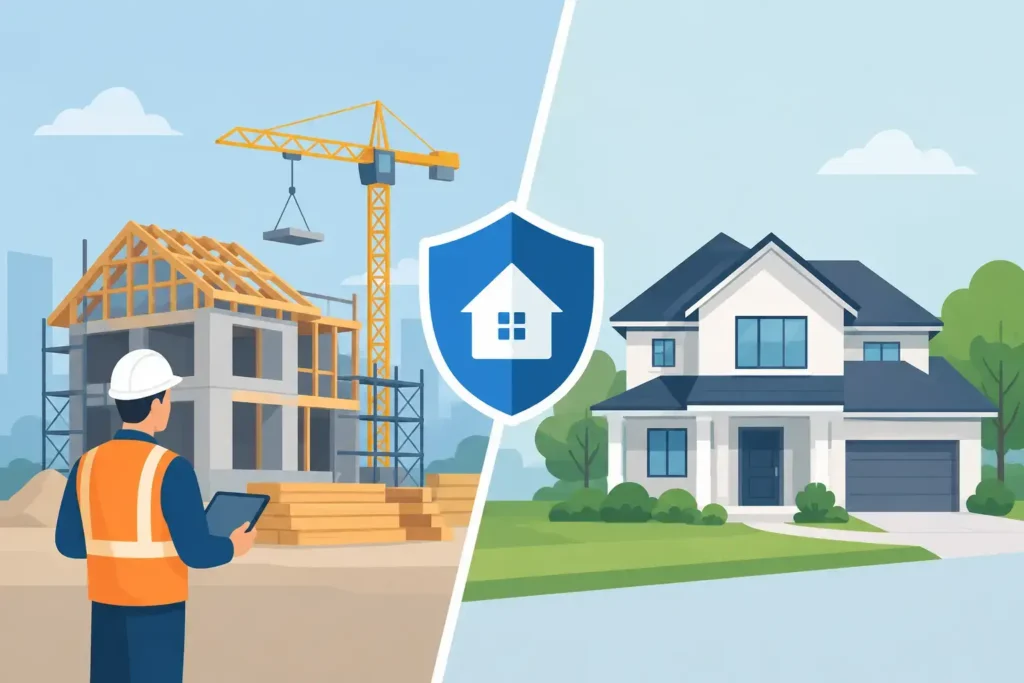
A half-finished building has a different risk profile than a finished one. Lumber may be stored outside, mechanical systems may not be installed, and several contractors may be coming and going every day. That is why the choice between builder risk vs property insurance matters well before the first materials arrive. The right policy can help protect the money tied up in a project. The wrong assumption can leave an owner or contractor paying for a major loss out of pocket.
For homeowners, developers, landlords, and business owners in New Jersey, New York, and Florida, the answer is not always one policy or the other. It often depends on whether the property is under construction, being renovated, occupied, or ready to operate.
Builder Risk vs Property Insurance: The Main Difference
Builder’s risk insurance is designed for a building or structure while it is under construction, renovation, or sometimes installation. It generally protects the value of the work in progress, including covered building materials and equipment, against certain causes of loss such as fire, wind, theft, vandalism, or lightning.
Commercial property insurance and homeowners insurance, on the other hand, are primarily designed for completed, occupied property. They can cover the building, business personal property, or personal belongings after the property is ready for its intended use. Coverage is built around the risks of owning or operating a finished location, not the changing conditions of an active jobsite.
The distinction sounds simple, but timing is critical. A standard property policy may restrict coverage or impose conditions when a building is vacant, undergoing extensive renovation, or being constructed from the ground up. Builder’s risk coverage fills a gap during that transitional period.
What Builder’s Risk Insurance Can Cover
A builder’s risk policy is typically purchased for a specific project and a defined construction period. The policy limit should reflect the completed value of the project, not merely the cost of materials currently on site. As the building takes shape, the amount at risk grows too.
Depending on the policy and endorsements selected, builder’s risk may cover the structure being built, materials intended for the project, and certain temporary structures or site equipment. Materials may be covered while on site and, in some cases, while in transit or temporarily stored elsewhere. Coverage details vary significantly by insurer, so this should never be assumed.
For example, if a fire damages framing and roofing materials midway through a retail buildout, builder’s risk may help pay to repair the damaged work and replace covered materials. If copper piping is stolen from an unoccupied renovation project, the policy may respond if theft is included and the policy’s protective safeguards have been met.
Builder’s risk also may be expanded to address expenses that can follow a covered loss, such as debris removal, increased costs to comply with certain building ordinances, or soft costs. Soft costs can include additional architect fees, loan interest, or permit expenses caused by a covered delay. These are not automatic features, but they can be valuable on larger or tightly financed projects.
What It Usually Does Not Cover
Builder’s risk is property coverage, not a complete construction insurance program. It generally does not cover injuries to third parties, damage a contractor causes to another person’s property, employee injuries, or defective workmanship itself. Those exposures may call for general liability, workers’ compensation, professional liability, or other coverage.
Flood and earthquake are commonly excluded or limited unless specifically added. Wind and water damage also deserve close attention in coastal and hurricane-prone parts of Florida, as deductibles and policy terms can be very different from standard fire coverage. A project with a builder’s risk policy can still have meaningful uninsured exposures if coverage is not tailored to its location and scope.
What Property Insurance Is Built to Protect
Property insurance is intended to protect a completed building and the property inside it once normal occupancy or operations begin. For a business, this can include the building, furniture, inventory, equipment, computers, and improvements made to a leased space. For a homeowner, it may include the dwelling, personal belongings, and additional living expenses after a covered loss.
A commercial property policy may also include business income coverage. If a covered fire forces a restaurant, office, or retail store to close, business income coverage can help replace qualifying lost income and continue certain ongoing expenses during the recovery period. That is a very different concern from a construction project that has not yet opened its doors.
Property insurance is not necessarily the better or broader policy. It is simply designed for a different stage in the life of the property. A policy written for a fully operating building may not adequately account for open walls, unfinished utilities, theft-prone materials, or an extended period without occupancy.
When You May Need One Policy, the Other, or Both
For new construction, builder’s risk is usually the starting point. The owner, developer, general contractor, or lender may be responsible for arranging it, depending on the construction contract. Everyone involved should understand who is purchasing the policy, whose interests are insured, and who is responsible for the deductible after a loss.
For a major renovation, the answer can be more layered. An existing commercial building may already have property insurance, but the renovation could require builder’s risk coverage or a renovation endorsement. The existing policy may continue to protect the completed portion of the building and its contents, while builder’s risk addresses the value of the new work. Coordination matters because overlapping policies do not automatically mean every loss is covered without dispute.
For a smaller update, such as replacing flooring in an occupied office, existing property coverage may be sufficient. For a full gut renovation, roof replacement, addition, or structural work, relying on a standard property policy can be risky. The scale of the work, the building’s occupancy, the value of materials, and the length of the project all influence the decision.
When construction is complete, builder’s risk coverage usually ends based on a stated trigger. That may be when the work is finished, when the owner accepts the project, when the building is occupied, or on the policy expiration date. A permanent property policy should be ready before that transition occurs. Waiting until the final inspection can create a last-minute coverage problem.
Questions to Settle Before Construction Begins
A clear conversation before work starts can prevent confusion after a loss. Ask who is responsible for insuring the project and whether the policy limit equals the completed replacement cost. Confirm whether the policy covers materials in transit, off-site storage, and materials supplied by the owner.
It is also wise to review deductibles, particularly wind, named storm, flood, and theft deductibles where applicable. A low premium can look attractive until a separate percentage deductible applies to a major weather claim. For projects with financing, confirm the lender’s insurance requirements early rather than revising coverage after closing.
Contract language deserves equal attention. Construction agreements often address insurance responsibilities, waiver of subrogation requirements, additional insured status, and responsibility for damage to the work. Those provisions should align with the actual policies in place. A contract cannot create coverage that the insurance policy excludes.
Common Mistakes That Create Gaps
One frequent mistake is insuring only the original construction budget. Material prices, labor costs, design changes, and code requirements can raise the completed value of a project. If the limit is too low, the insured may face a coinsurance penalty or inadequate funds to rebuild after a serious loss.
Another mistake is assuming a contractor’s insurance protects the owner’s investment in the project. A contractor’s general liability policy is essential, but it typically does not insure the building under construction as first-party property. Likewise, a contractor’s tools policy is not a substitute for builder’s risk coverage on the structure and project materials.
Owners also sometimes overlook security requirements. A carrier may expect fencing, locked storage, alarms, regular site visits, or protections against freezing pipes. Failing to meet a stated condition can complicate a claim, especially at an unoccupied site.
A Practical Way to Choose the Right Coverage
Start with the project itself: Is the structure new, renovated, vacant, occupied, or already operating? Then identify the total completed value, the construction timeline, the parties involved, and the local hazards that could affect the site. From there, compare the policy terms rather than comparing premiums alone.
At NewEdge Insurance Agency, the goal is to make those conversations clear. A thoughtful review can help identify where builder’s risk ends, where property insurance begins, and which related liability or specialty policies may be needed around the project.
Before construction starts or a major renovation changes the risk at your property, take time to review the plan with an insurance professional who will ask the practical questions. That early guidance can protect far more than the building – it can protect the timeline, financing, and confidence behind the project.