
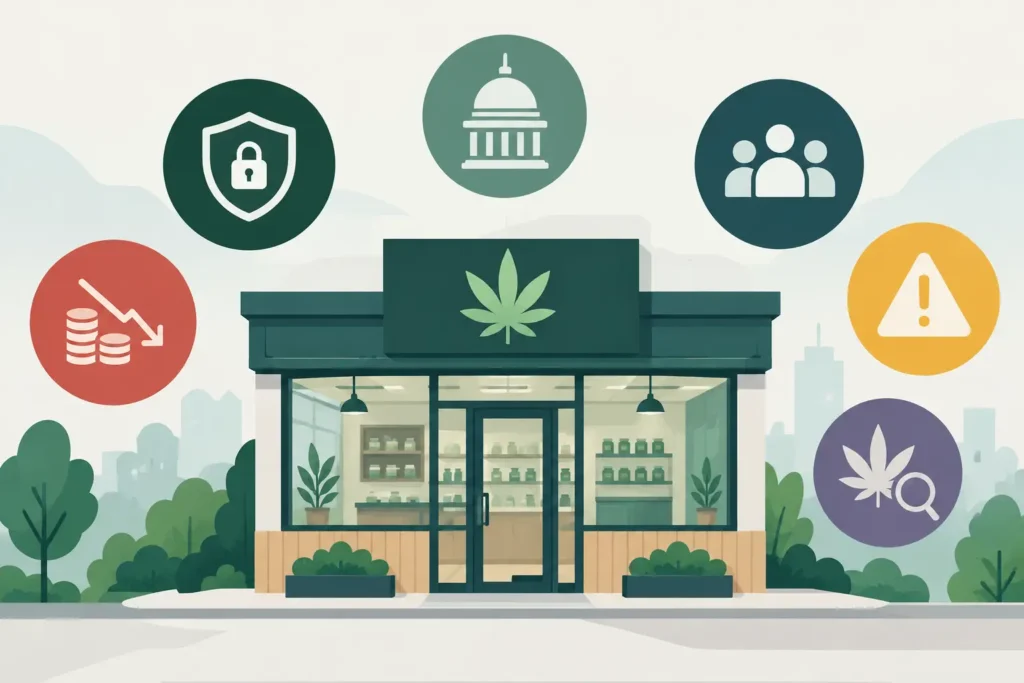
A dispensary can have a strong location, loyal customers, and quality products, then face a costly setback in a single afternoon. A break-in, a mislabeled product, a point-of-sale outage, or an unexpected inspection can interrupt operations quickly. Understanding the top risks facing cannabis dispensaries helps owners make practical decisions before a claim, fine, or lawsuit puts hard-earned progress at risk.
Cannabis retail is not like ordinary retail. Operators manage valuable inventory, sensitive customer information, strict state requirements, and a business environment that can change faster than many insurance policies are reviewed. The right protection starts with looking at the business as a whole, not simply checking a box for general liability coverage.
Top Risks Facing Cannabis Dispensaries
Regulatory and licensing exposure
Dispensaries operate under detailed state and local rules covering licensing, ownership, security, inventory tracking, advertising, packaging, employee training, and more. In New Jersey, New York, and Florida, requirements and market structures differ significantly. Even within one state, local ordinances may add another layer of obligations.
A compliance problem does not always come from intentional misconduct. It may begin with an employee who fails to follow an ID-verification procedure, an inventory discrepancy that is not documented correctly, or a vendor relationship that creates a licensing concern. The consequences can include fines, a temporary shutdown, license discipline, legal expenses, and lost income.
Insurance does not replace a compliance program or pay every regulatory penalty. Some fines and intentional acts may not be insurable. Still, coverage for certain legal defense costs, management liability allegations, or related operational losses may be available depending on the policy wording. Owners should review coverage alongside their legal and compliance advisers, especially when opening a new location or adding delivery, cultivation, or manufacturing operations.
Theft, burglary, and employee dishonesty
Cannabis inventory has a high value and can be attractive to criminals. Dispensaries may also have substantial cash-handling exposure, even as banking options continue to improve. A forced entry can damage doors, windows, safes, cameras, and inventory all at once. Internal theft can be harder to detect and may build gradually through manipulated records, improper discounts, or product diversion.
A commercial property policy may help pay for covered damage to the building, equipment, and stock after a qualifying loss. Crime coverage can address certain theft-related losses, including employee dishonesty, when it is specifically included. The details matter. Limits for cannabis inventory, cash, theft away from the premises, and losses involving employees can vary considerably.
Security planning is just as important as coverage. Working cameras, restricted access areas, safe procedures, alarm monitoring, documented cash counts, and separation of employee duties all reduce opportunities for loss. A policy should support these controls, not substitute for them.
Product liability and product recall concerns
Customers expect cannabis products to be accurately labeled, properly packaged, and safe for their intended use. When a customer alleges an injury, illness, incorrect potency, contamination, or inadequate warning, the dispensary may be named in a claim even if the product was made by someone else.
This is one reason product liability deserves close attention. A standard general liability policy may have exclusions or limitations related to cannabis, ingestible products, or product-related claims. Dispensary owners need to confirm that their coverage is designed for their actual operations and product mix, including flower, concentrates, edibles, beverages, topicals, accessories, and private-label goods.
Recalls can create a separate financial problem. Pulling affected products from shelves may mean lost inventory, customer notifications, disposal costs, and a serious interruption to normal business. Product recall coverage is not automatically part of every policy, and it may be more valuable for some operations than others. A retailer selling only established third-party brands may have a different exposure than a dispensary that white-labels products or operates multiple connected cannabis businesses.
Cyberattacks and payment-system disruption
A dispensary’s digital systems hold more than inventory counts. Point-of-sale platforms, customer profiles, loyalty programs, employee files, surveillance systems, and vendor records can all create cyber exposure. A ransomware event or data breach can stop sales, create notification obligations, and damage customer trust.
Cybercriminals often look for businesses that rely heavily on technology but may not have a dedicated internal security team. A fraudulent email can lead to a stolen vendor payment. A compromised employee password can provide access to customer data. A system outage can leave staff unable to process transactions or reconcile regulated inventory.
Cyber insurance can help with expenses such as forensic investigation, breach response, data restoration, legal guidance, customer notification, and certain business interruption losses. Coverage varies widely, so owners should ask direct questions about ransomware, social engineering, payment-card exposure, regulatory defense, and system-dependent income loss.
Basic safeguards are practical and effective: require multifactor authentication, limit administrator access, train employees to spot suspicious messages, keep software updated, and maintain secure backups. These steps may also help meet insurer requirements.
Premises liability and customer safety
A dispensary is a customer-facing business, which means ordinary retail risks still apply. A wet floor, broken walkway, poor lighting, overcrowded waiting area, or inadequate security response can lead to an injury claim. If the business hosts events, offers consultations, or manages a busy parking area, the exposure may increase.
General liability coverage is a central part of a dispensary insurance program because it can respond to covered third-party bodily injury and property damage claims. But coverage limits should reflect the size of the operation, customer volume, lease requirements, and whether the business has multiple locations.
Security-related claims deserve careful consideration as well. No policy can prevent a violent incident, but thoughtful security procedures, trained employees, incident reporting, and appropriate liability coverage can help a business respond responsibly if one occurs. Owners should also review the lease. Landlords may require specific insurance limits, additional insured status, or responsibility for certain areas of the property.
Property damage and business interruption
Fire, water damage, wind, electrical failure, vandalism, and equipment breakdown can close a dispensary without warning. In Florida, wind and flood exposure may shape the property conversation. In New Jersey and New York, winter weather, aging buildings, water damage, and regional storm activity can be major concerns. Flood damage is commonly excluded from standard commercial property policies, so businesses in or near flood-prone areas may need separate protection.
The immediate property loss is only one part of the problem. If a location cannot open for several weeks, the business may still owe rent, payroll, loan payments, and vendor obligations. Business income coverage can help replace lost income and pay certain continuing expenses after a covered property loss. The policy’s restoration period, waiting period, and stated limits should be realistic for the time it would take to rebuild, restock, complete inspections, and reopen.
Equipment breakdown coverage can also matter where refrigeration, HVAC, security equipment, point-of-sale hardware, or electrical systems are essential to operations. It is a different risk from a fire or storm, and it is often overlooked until a critical system fails.
Employment practices and management claims
As dispensaries grow, employee-related issues can become more complex. Claims involving wrongful termination, discrimination, harassment, retaliation, wage-and-hour practices, or failure to promote can be expensive to defend, regardless of whether the allegation is ultimately proven.
Employment practices liability insurance may help with covered employee claims that general liability policies typically do not address. Directors and officers liability coverage can also be relevant for owners, officers, and board members facing certain management-related allegations. These coverages are especially worth reviewing for multi-location operators, businesses seeking investment, or companies with formal leadership teams.
Clear hiring practices, employee handbooks, consistent training, reliable timekeeping, and documented performance conversations can reduce risk. The goal is not to treat every personnel decision as a legal problem. It is to create fair, repeatable processes that protect both employees and the business.
Building a More Practical Protection Plan
There is no single policy that solves every dispensary risk. A small independent retailer may need a different approach than a vertically integrated operator with cultivation, manufacturing, delivery, and several storefronts. The best starting point is a clear conversation about how the business earns revenue, stores product, uses technology, handles cash, and would recover after a disruption.
NewEdge Insurance Agency helps business owners review those real-world exposures in plain English, so coverage decisions are based on the way the operation actually works. An annual review is particularly valuable in cannabis, where a new product line, location, lease, lender, investor, or state rule can change the risk picture.
The most useful insurance conversation happens before an incident, while there is time to correct a gap, strengthen a procedure, and choose coverage with care. That preparation gives dispensary owners more room to focus on serving their communities and growing a business built to last.